
Introduction
Custom robotic welding services are widely used in modern metal fabrication because they help improve weld consistency, production efficiency, and overall product quality. For metal frames, brackets, housings, and OEM assemblies, robotic welding can provide stable weld seams and repeatable results for both small batch and mass production projects.
Compared with fully manual welding, robotic welding is especially suitable for repeated parts that require consistent dimensions, stable fixtures, and reliable welding quality. It is an efficient solution for manufacturers looking for high-quality welded metal components.
For OEM buyers, robotic welding is useful when welded assemblies require consistent bead quality, repeatable positioning, and stable batch production. It is commonly used for metal frames, brackets, housings, support structures, and fixture-based welded parts where manual welding may create more variation.
Before quotation, it is helpful to provide 2D drawings, 3D files, material grade, thickness, weld requirements, expected quantity, and any inspection standards. Clear project information helps us evaluate fixture design, welding sequence, deformation control, and production feasibility.
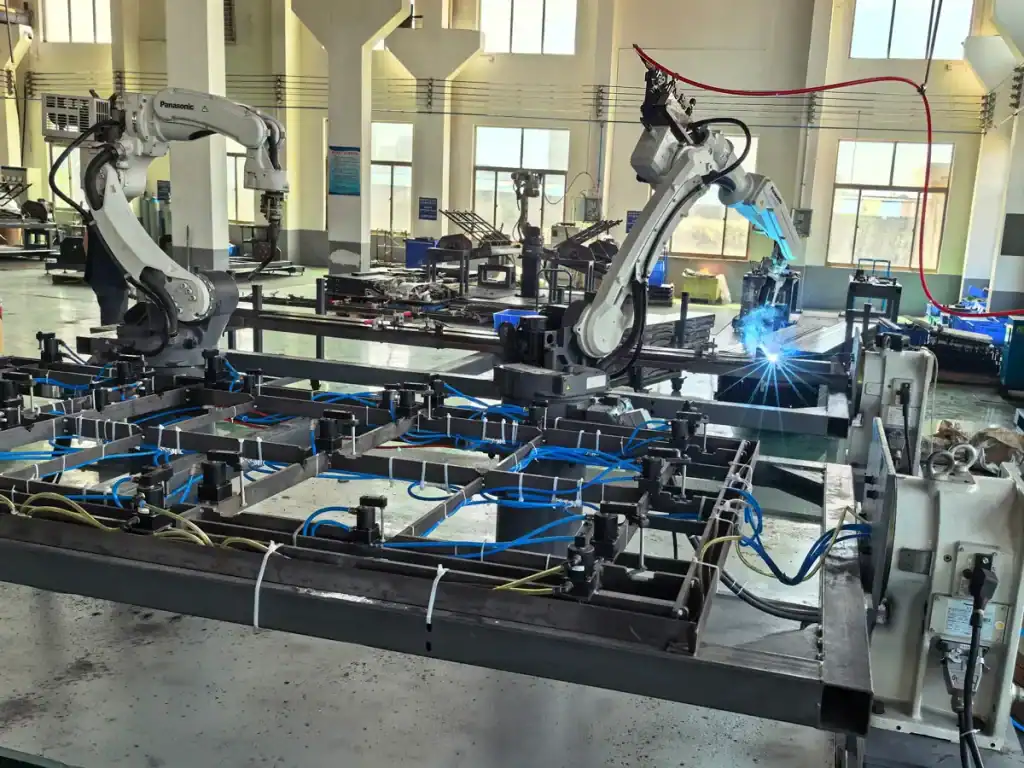
Custom Robotic Welding Services for OEM Parts
Custom robotic welding services use industrial robots to perform welding operations based on programmed welding paths and controlled welding parameters. The robot can move the welding torch accurately and repeat the same welding process for each part.
This process is commonly used for MIG/MAG welding and automated welding applications. It is suitable for custom metal parts that are produced according to drawings, samples, or specific project requirements.
Robotic welding is often used for parts such as:
- Metal frames
- Brackets
- Equipment housings
- Structural components
- Machinery parts
- OEM welded assemblies
Robotic Welding for Metal Frames
Metal frames are commonly used in machinery, equipment, transportation, construction, and industrial applications. These parts often require strong welds, accurate positioning, and stable structural performance.
Robotic welding is a good choice for metal frames because it can maintain consistent weld paths and stable welding speed. When fixtures are properly designed, the robot can weld repeated frame structures with high efficiency and reliable quality.
For batch production, robotic welding helps reduce variation between parts and improves production consistency.
Robotic Welding for Brackets and Housings
Brackets and housings are important components in many metal fabrication projects. They may require precise welding, clean appearance, and strong connections.
Robotic welding can help produce consistent weld seams for brackets, covers, cabinets, enclosures, and equipment housings. This is especially useful when the same design needs to be produced repeatedly.
For OEM projects, stable welding quality helps improve assembly accuracy and reduce rework during later production stages.
Robotic Welding for OEM Assemblies
OEM assemblies often require multiple metal parts to be welded together according to specific drawings and technical requirements. These projects may involve different materials, part sizes, thicknesses, and welding positions.
Custom robotic welding services can support OEM production by providing repeatable welding quality and efficient batch processing. With proper programming and fixtures, robotic welding can help manufacturers achieve stable production results.
It is suitable for OEM assemblies used in:
- Industrial machinery
- Agricultural equipment
- Automotive parts
- Construction equipment
- Metal enclosures
- Custom equipment components
Materials Suitable for Robotic Welding
Robotic welding can be used for different metal materials depending on the project requirements. Common materials include carbon steel, stainless steel, and some coated metal materials.
Carbon steel is one of the most widely used materials for robotic welding. It is commonly used in frames, brackets, and structural components.
Stainless steel can also be welded with robotic systems when clean weld appearance and corrosion resistance are required.
For each project, the welding process should be selected based on material type, thickness, part design, and final application.
Benefits of Robotic Welding for Batch Production
Robotic welding offers several advantages for repeated production and OEM metal fabrication projects.
Key benefits include:
- Consistent weld quality
- Higher production efficiency
- Reduced welding variation
- Better repeatability
- Stable welding speed
- Improved production control
- Suitable for batch and mass production
Once the welding program and fixtures are ready, robotic welding can help improve production speed while maintaining stable quality across multiple parts.
Quality Control in Robotic Welding
Quality control is important in every welding project. For robotic welding, stable fixtures, correct welding parameters, and proper inspection are all important parts of the production process.
Common quality control steps include:
- Checking drawings and welding requirements
- Confirming material type and thickness
- Designing suitable fixtures
- Testing welding parameters
- Inspecting weld appearance
- Checking dimensions after welding
- Performing final quality inspection before delivery
Good quality control helps ensure that welded parts meet customer requirements and are suitable for final assembly or use.
Why Choose Custom Robotic Welding Services?
Custom robotic welding services are a strong solution for manufacturers that need stable quality, efficient production, and reliable delivery. They are especially useful for repeated parts and OEM metal assemblies.
For customers with drawings, samples, or technical requirements, robotic welding can help turn designs into finished welded components with consistent quality.
We provide robotic welding services for custom metal frames, brackets, housings, and OEM assemblies. Our team can support metal fabrication projects from drawing review to welding, inspection, and delivery.
Conclusion
Custom robotic welding services are ideal for metal frames, brackets, housings, and OEM assemblies that require consistent weld quality and efficient production. With proper fixtures, controlled welding parameters, and quality inspection, robotic welding can help improve production stability and reduce variation between parts.
Looking for custom robotic welding services for your metal parts? Send us your drawings, samples, or project requirements, and our team will provide a fast quotation for your welded metal components.
Need production robotic welding for your frames, brackets, or assemblies? Explore our robotic welding services or send us your drawings for a quote.