
Robotic welding and manual welding are both widely used in metal fabrication. Each method has its own advantages depending on the project type, production quantity, material, and quality requirements.
For OEM welded assemblies, the choice between robotic welding and manual welding depends on part structure, batch quantity, weld access, appearance requirements, and quality consistency. Robotic welding is often suitable for repeatable metal frames, brackets, housings, and welded structures, while manual welding remains useful for prototypes, small batches, complex positions, and repair work.
Before quotation, buyers can provide 2D drawings, STEP files, material grade, thickness, weld length, weld position, expected quantity, surface finish requirements, and inspection standards. Clear project information helps us evaluate whether robotic welding, manual welding, or a combined welding process is more suitable for production.
For custom metal parts, frames, brackets, housings, and OEM assemblies, choosing the right welding method can improve production efficiency, reduce defects, and ensure consistent weld quality.
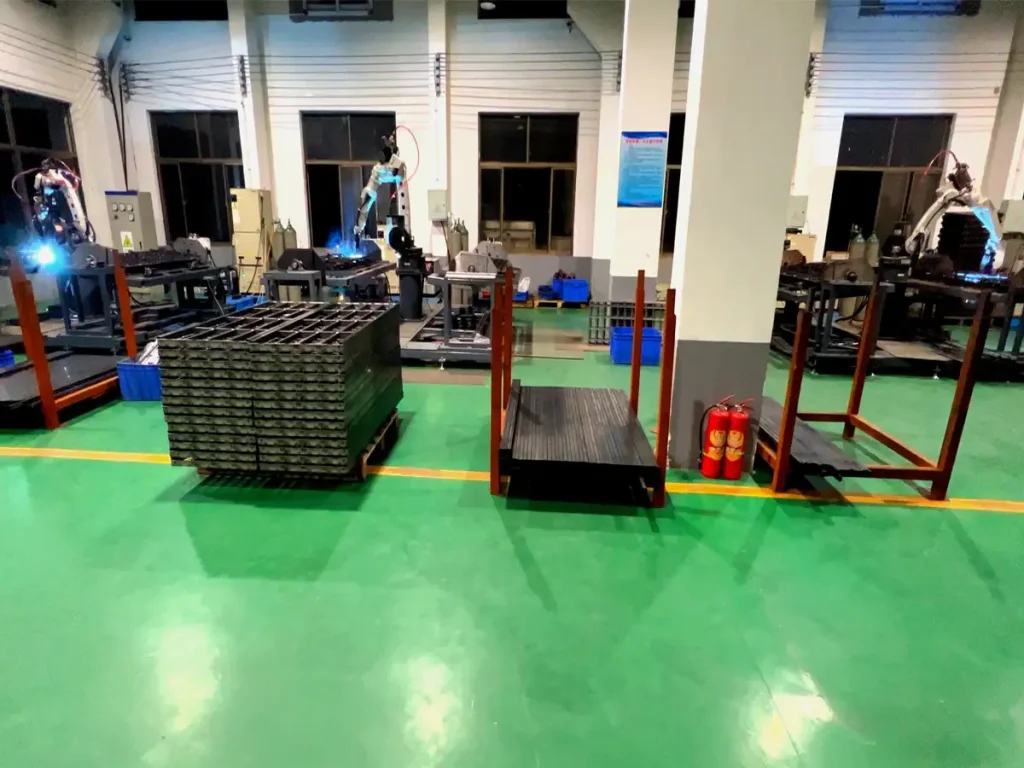
What Is Robotic Welding?
Robotic welding uses industrial robots to complete welding operations automatically. The robot follows programmed paths to weld metal parts with high precision and repeatability.
Robotic welding is commonly used for MIG/MAG welding, spot welding, and other automated welding processes. It is especially suitable for repeated parts, batch production, and projects that require consistent weld seams.
What Is Manual Welding?
Manual welding is performed by skilled welders who control the welding torch by hand. This method is flexible and useful for small quantities, repair work, complex one-off parts, and projects that require human adjustment during welding.
Manual welding depends heavily on the experience and skill of the welder. For low-volume custom projects, it can still be a practical solution.
Key Differences Between Robotic Welding and Manual Welding
- Welding Consistency
Robotic welding provides more consistent weld quality because the robot follows the same path and parameters for every part. This helps reduce variation between parts.
Manual welding can also produce high-quality welds, but the result may vary depending on the welder’s skill, working conditions, and fatigue.
- Production Speed
Robotic welding is usually faster for repeated parts and batch production. Once the program and fixtures are ready, the robot can weld continuously with stable speed.
Manual welding is more flexible, but it is generally slower for large quantities because each part requires direct labor.
- Labor Cost and Efficiency
Robotic welding can reduce long-term labor costs for repeated production. It also improves production efficiency by reducing manual operation time.
Manual welding may have lower setup cost for small orders, but labor cost can increase when production volume becomes larger.
- Welding Quality
Robotic welding provides stable arc control, accurate torch movement, and repeatable weld seams. This is important for structural parts, brackets, frames, housings, and OEM components.
Manual welding is useful for parts that require special handling, repair, or on-site adjustment.
- Setup Requirements
Robotic welding requires programming, fixtures, and stable part positioning. It is best suited for projects with repeated designs or batch production.
Manual welding requires less initial setup and can be easier for one-off parts or urgent small orders.
When Should You Choose Robotic Welding?
Robotic welding is a good choice when your project requires:
- High production efficiency
- Consistent weld quality
- Repeated metal parts
- Batch or mass production
- Stable dimensions and fixtures
- Reduced welding variation
- Reliable quality control
It is commonly used for automotive parts, machinery frames, metal brackets, equipment housings, structural components, and custom OEM metal parts.
When Should You Choose Manual Welding?
Manual welding may be better when your project requires:
- Small quantity production
- Repair welding
- Complex one-off parts
- On-site welding work
- Flexible adjustment during welding
- Special shapes that are difficult to fixture
For prototype projects, manual welding may sometimes be used first before switching to robotic welding for batch production.
Which Welding Method Is Better?
There is no single answer for every project. Robotic welding is better for consistency, speed, and repeated production. Manual welding is better for flexibility, repair work, and small-volume custom jobs.
For many metal fabrication projects, both methods can be used together. Manual welding can support prototypes and special parts, while robotic welding can handle repeated production with stable quality.
Conclusion
Robotic welding and manual welding both play important roles in modern metal fabrication. If your project requires consistent weld quality, faster production, and repeatable results, robotic welding is a strong solution.
Looking for professional robotic welding services? We provide robotic welding for custom metal parts, frames, brackets, housings, and OEM assemblies. Send us your drawings and project requirements to get a fast quotation.
Whether your project suits robotic or manual welding, our robotic welding services cover both for prototypes and batch production.
Learn more about our Panasonic robotic welding process, or explore robotic welding services for your OEM parts.
Choosing a welding process for production
If your parts need repeatable weld quality, compare the process with our robotic welding services and full metal fabrication capabilities. You can also send drawings for process review.