
Panasonic robotic welding is widely used in modern metal fabrication for projects that require stable weld quality, repeatable results, and efficient production. For custom metal parts, frames, brackets, housings, and OEM assemblies, automated welding can help improve consistency and reduce variation between parts.
Panasonic robotic welding equipment is used for repeatable welding of OEM metal frames, brackets, housings, and welded assemblies. With suitable fixtures, stable welding parameters, and consistent positioning, robotic welding can help improve batch quality, reduce variation, and support long-term production orders.
For quotation, buyers can provide 2D drawings, STEP files, material grade, thickness, weld requirements, fixture requirements, surface finish requirements, quantity, and inspection standards. Clear project information helps us evaluate welding feasibility, deformation control, production rhythm, and quality inspection before manufacturing.
Compared with fully manual welding, a robot welding system is especially useful when the same part needs to be produced repeatedly. With proper fixtures, welding parameters, and inspection, the process can support both small batch production and larger manufacturing orders.
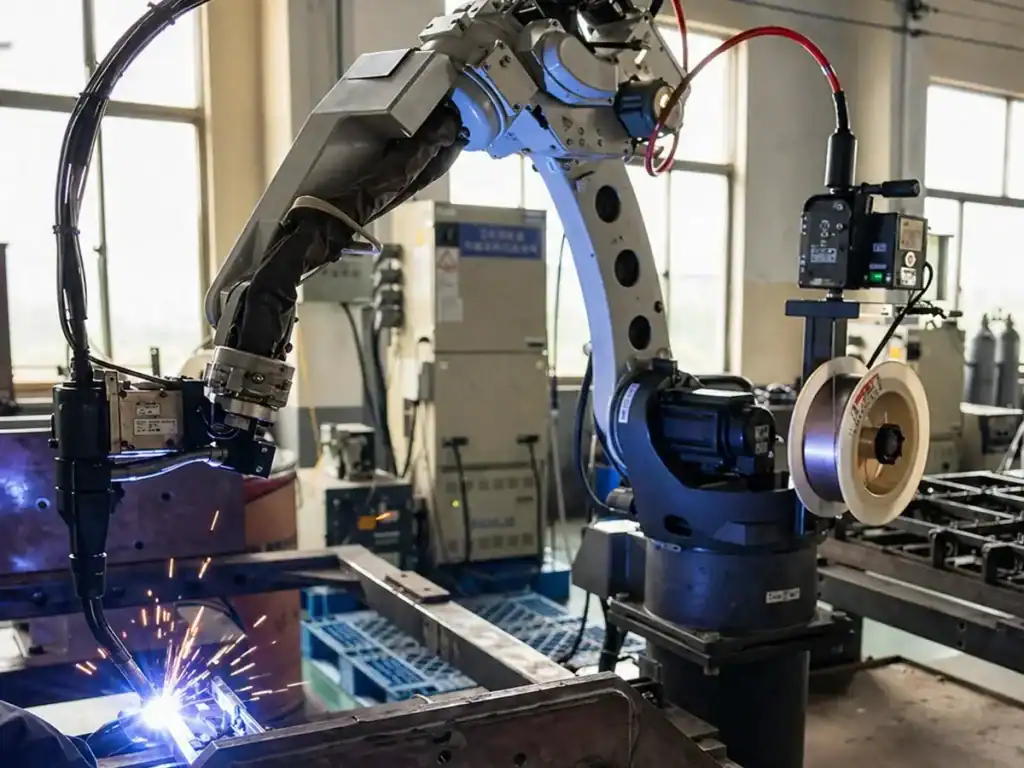
What Is Panasonic Robotic Welding?
Panasonic robotic welding uses industrial robots, welding power sources, control systems, and programmed welding paths to complete welding operations automatically. The robot follows a set path and applies controlled welding parameters to each part.
This type of system is commonly used for MIG/MAG welding and other automated welding applications. It is suitable for metal components that need consistent weld seams, stable positioning, and reliable quality across repeated production.
How the Welding Process Works
The process usually starts with a customer drawing, sample, or technical requirement. Before production, the part design, material type, thickness, welding position, and fixture method need to be reviewed.
A fixture is then prepared to hold the parts in the correct position. After programming and testing, the welding robot follows the planned path to complete the welds. During production, operators check weld appearance, dimensions, and overall quality to make sure the finished parts meet project requirements.
Key process steps include:
- Reviewing drawings and welding requirements
- Confirming material type and thickness
- Designing or preparing fixtures
- Setting welding parameters
- Programming the robot path
- Testing sample parts
- Inspecting weld quality before batch production
Materials Suitable for Robotic Welding
Robotic welding can be used for different metal materials depending on the project design and final application.
Common materials include:
- Carbon steel
- Stainless steel
- Mild steel
- Aluminum
- Galvanized steel
- Custom sheet metal components
- Structural metal parts
For carbon steel parts, automated welding can provide strong welds and good production efficiency. For stainless steel components, stable control helps improve weld appearance and reduce unnecessary rework. Aluminum welding requires more attention to heat control, fixture accuracy, and welding parameters, but it can also be supported when the process is properly prepared.
Common Applications
This welding method is often used in OEM metal fabrication projects where parts need repeatable quality and stable production.
Common applications include:
- Metal frames
- Mounting brackets
- Equipment housings
- Machinery components
- Structural parts
- Automotive-related parts
- Agricultural equipment parts
- Custom OEM welded assemblies
For parts used in final assembly, consistent weld quality is important. If welding is unstable, it may cause dimensional errors, assembly problems, weak joints, or additional rework. A robotic system can help reduce these risks when the part design and fixtures are suitable.
Benefits for OEM Manufacturing
Panasonic robotic welding can provide several advantages for repeated metal fabrication projects.
Main benefits include:
- Consistent weld seams
- Better repeatability between parts
- Higher production efficiency
- Reduced manual welding variation
- Stable welding speed
- Improved quality control
- Suitable for batch production
- Better support for long-term OEM projects
For one-off parts or highly complex repair work, manual welding may still be more flexible. However, when customers need repeated parts with stable quality, robotic welding is often a practical solution.
Quality Control in Robotic Welding
Quality control is important throughout the welding process. Good results depend not only on the robot, but also on proper fixtures, correct parameters, suitable materials, and final inspection.
Common quality checks include:
- Confirming drawing requirements
- Checking part positioning before welding
- Inspecting weld appearance
- Checking dimensions after welding
- Testing sample parts before batch production
- Performing final inspection before delivery
These steps help ensure that welded parts are suitable for assembly, surface finishing, and final use.
Why Choose Robotic Welding Services?
For manufacturers that need stable quality, efficient production, and repeatable welded components, robotic welding services can be a strong solution. The process is suitable for many custom metal fabrication projects, especially when parts are produced in repeated quantities.
We provide welding support for metal frames, brackets, housings, and OEM assemblies based on drawings, samples, and technical requirements. Our team can help with welding process review, fixture preparation, production, inspection, and delivery.
Looking for custom welded metal parts? Send us your drawings, samples, or project requirements, and our team can provide a fast quotation.
Want Panasonic robotic welding for your OEM parts? Learn more on our robotic welding services page.
Robotic welding production resources
For frame, bracket, and OEM assembly work, see our robotic welding services and project examples. To evaluate your drawings, contact Likai Metal.