
For many OEM metal fabrication projects, production planning starts with the customer’s drawings. Part size, welding length, tolerance requirements, batch quantity, delivery schedule, and final assembly needs all affect how the production line should be arranged.
For long metal frames and welded assemblies, robotic welding capacity depends on part size, fixture design, weld access, positioning repeatability, and batch production requirements. Proper fixtures and stable welding parameters help control distortion, improve weld consistency, and support repeat orders for OEM metal fabrication projects.
Before quotation, buyers can provide 2D drawings, STEP files, frame dimensions, material grade, thickness, weld requirements, expected quantity, and inspection standards. Clear project information helps us evaluate fixture feasibility, welding sequence, handling method, and production capacity for long frame assemblies.
At Likai Metal, we do not treat every order with the same fixed process. When a project requires higher welding capacity or special part dimensions, we adjust the production layout, welding fixtures, equipment configuration, and manpower plan to support stable delivery. This is part of our custom metal fabrication capabilities for drawing-based OEM projects.
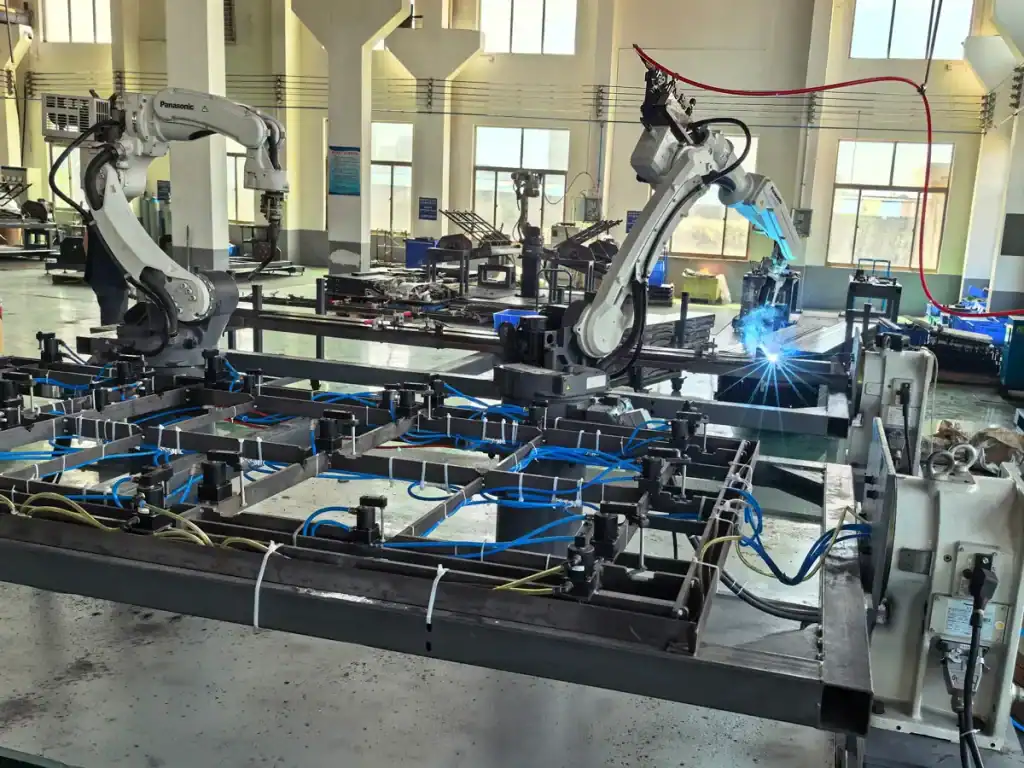
A Custom Welding Setup for Long Metal Frames
The photo shows a custom Panasonic robotic welding workstation configured for long metal frame assemblies. This setup was arranged for a customer order that required extended frame structures, consistent weld quality, and repeatable production output.
Long frame parts are more demanding than small welded brackets. The welding path is longer, the fixture must hold the structure accurately, and heat input needs to be controlled to reduce distortion. A robotic welding workstation helps keep weld position, welding speed, and weld quality more consistent from one part to the next.
For repeat-production applications involving robotic-welded brackets and smaller frames, see our dedicated application guide.
Adjusting Production Capacity Around the Order
When customer drawings show that a project needs larger parts or higher volume, we review the full production route before starting mass production. This may include adjusting the welding line layout, designing or modifying dedicated fixtures, adding robotic welding capacity, preparing additional tooling, arranging inspection checkpoints, and planning the flow from surface finishing to packing and shipment.
This order-based adjustment helps us avoid bottlenecks and keep production moving from laser cutting, bending, and welding to dimensional inspection, surface finishing, assembly, packing, container loading, and sea freight delivery.
Why Robotic Welding Helps OEM Projects
Robotic welding is especially useful for repeatable OEM metal parts. Once the welding program and fixture are confirmed, the process can produce consistent welds across batches. For long metal frames, this helps improve welding accuracy, reduce manual variation, increase production efficiency, and support more stable delivery schedules.
Manual welding is still important for prototypes, small batches, repair work, and complex areas that require flexible handling. But for repeatable long frame assemblies, robotic welding gives the project a stronger production foundation.
From Customer Drawings to Stable Delivery
Our goal is not only to make one sample successfully. For OEM projects, the real challenge is stable repeat production. By adjusting equipment, fixtures, and production capacity around the customer’s drawings, Likai Metal can support custom metal frame orders from prototype review to batch manufacturing and delivery. You can also review our OEM metal parts project examples to see how different process routes are organized.
If your project involves long welded frames, machinery structures, automation equipment frames, or custom OEM metal assemblies, send us your drawings for review. We can evaluate the process route, welding method, fixture needs, surface finishing, packing, and delivery plan before production starts.