
Robotic Welding Services for Custom Metal Parts and OEM Assemblies
Likai Metal uses Panasonic robotic welding technology alongside skilled manual MIG/MAG and TIG welders. We weld carbon steel, stainless steel, aluminum, and galvanized steel into frames, brackets, housings, and complete OEM assemblies. Robotic welding gives our customers consistent weld quality across the entire batch and reliable delivery on production runs.
Ready to request a robotic welding quote? Send us your assembly drawings, weld symbols, material grade, quantity, fixture requirements, and inspection notes. Our team can review the welding sequence, fixture feasibility, and production route before quoting. Contact Likai Metal to send your drawings.
Likai Metal provides robotic welding services for OEM metal frames, brackets, housings, guards, and welded assemblies. With proper fixtures, stable welding parameters, and repeatable positioning, robotic welding can help improve batch consistency, reduce variation, and support long-term production orders.
For robotic welding projects, buyers can provide 2D drawings, STEP files, material grade, thickness, weld requirements, fixture requirements, surface finish requirements, expected quantity, and inspection standards. Clear project information helps us review welding feasibility, fixture design, deformation control, production rhythm, and quality inspection before manufacturing. Send us your drawings and welding requirements to review robotic welding feasibility before production.
For a real production-capacity example, see how we configured a custom Panasonic robotic welding station for long OEM metal frame orders based on customer drawings, part size, and delivery requirements.
We scale our welding capacity to match your order, from small batches to larger production runs.
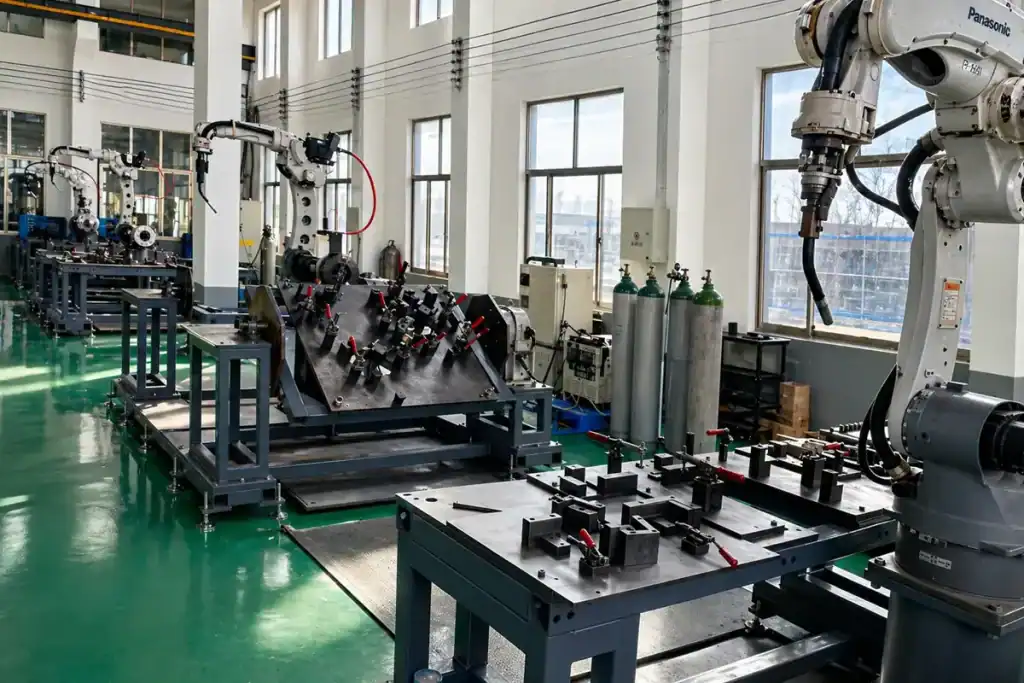
Our Robotic Welding Capabilities
- Panasonic robotic MIG/MAG welding for carbon steel and structural assemblies
- Robotic and manual TIG welding for stainless steel and aluminum
- Manual MIG and TIG for prototypes, repairs, and complex one-off assemblies
- Welded frame and bracket assemblies with custom fixturing
- Pre- and post-weld processes in-house: laser cutting, bending, drilling, grinding, finishing
Materials We Weld
- Carbon steel
- Stainless steel
- Aluminum
- Galvanized steel
Why Choose Our Robotic Welding Services
- Consistent weld quality and repeatability across batches
- High production efficiency for medium and large runs
- Suitable for complex metal parts and assemblies
- Quality inspection on every assembly
- Fast turnaround and competitive pricing
Applications
Automotive parts, machinery components, equipment frames, metal brackets, industrial structures, housings, and custom OEM metal assemblies.
Lead Times
Lead times depend on assembly size, complexity, and quantity. We confirm a delivery schedule for your specific order together with every quotation.
Common Robotic Welded Parts
Our robotic welding service is commonly used for welded frames, brackets, base plates, guards, housings, racks, support structures, equipment panels, fixture components, and OEM metal assemblies. For repeat production, robotic welding helps keep weld position, bead appearance, and assembly consistency stable from batch to batch.
Many projects combine welding with upstream cutting and forming. You can review our full manufacturing capabilities to see how robotic welding works with laser cutting, bending, CNC machining, surface finishing, and inspection.
Files and Information Needed for Quotation
For a faster welding quotation, please send 2D drawings, 3D files, material grade, thickness, quantity, weld symbols or welding requirements, surface finish, coating requirements, and any assembly tolerance or inspection points. Photos or samples are also useful when replacing an existing welded part.
If you are planning a new welded assembly, these related guides may help: robotic welding for OEM assemblies, robotic welding for metal frames and brackets, and robotic welding vs manual welding.
Welding Quality Control
Before production, we review drawings, weld locations, material thickness, fixture needs, distortion risk, and appearance requirements. For repeat parts, proper fixture design and stable welding parameters help improve consistency and reduce rework.
Quality control can include visual weld inspection, dimensional checks, fixture verification, first-article review for new assemblies, and final inspection before packing. When required, we can also coordinate finishing steps such as grinding, polishing, powder coating, plating, or painting after welding.
Robotic Welding FAQ
When is robotic welding better than manual welding?
Robotic welding is usually best for repeat parts, medium or larger production runs, and assemblies where consistent weld quality and repeatable positioning are important. Manual welding is still useful for prototypes, repair work, and low-volume complex assemblies.
What materials can you weld?
We commonly weld carbon steel, stainless steel, aluminum, and galvanized steel. The best welding process depends on the material grade, thickness, part structure, and appearance requirements.
Can you make complete welded assemblies?
Yes. We can support cutting, bending, machining, welding, surface finishing, inspection, and packing for complete build-to-print metal assemblies.
What should I send for a welding quote?
Please send drawings or 3D files, material, thickness, quantity, weld requirements, surface finish, coating needs, and any critical dimensions. If you only have a sample or photo, send that first and our team can advise what information is still needed.
Get a Quote
Send us your drawings, material requirements, welding specifications, and quantity. Our team will review your project and provide a fast quotation.
When your welded frame or assembly drawings are complete, Likai Metal can produce them through build-to-print manufacturing with welding, inspection, and delivery handled by one factory team.
If your welded assembly project is still being defined, compare build to print vs build to spec to choose the right RFQ approach.